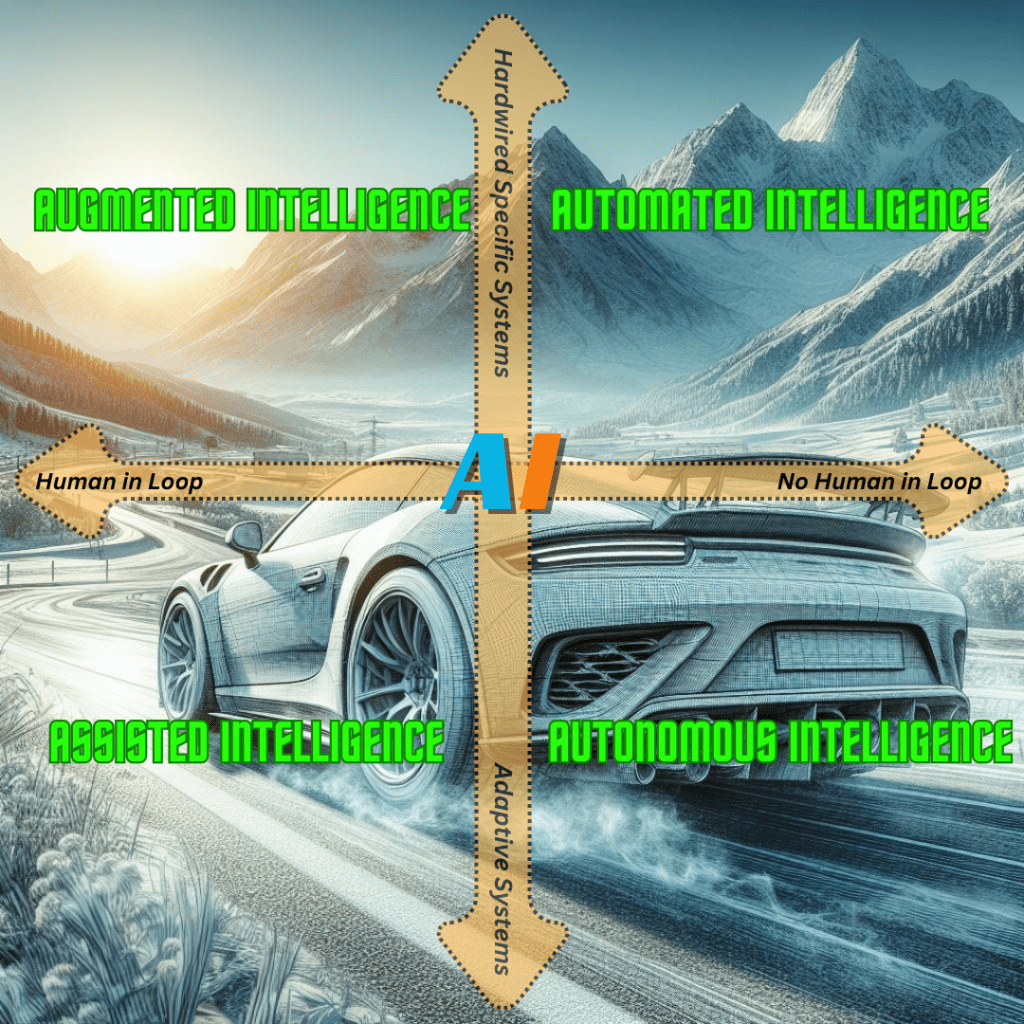
Imagine driving down a winding road, surrounded by the beauty of nature, with the wind gently caressing your face. As you navigate the twists and turns, you rely on your trusty companion, your car, to guide you safely to your destination. But have you ever stopped to think about the intelligence behind the wheel? In today’s world, cars are not just machines; they are becoming increasingly intelligent, thanks to advancements in artificial intelligence (AI). Let’s embark on a journey through four quadrants of AI, exploring how they shape the features and functionalities of modern cars.
Assisted Intelligence (Human in loop, Adaptive systems)
- This quadrant represents systems where humans are actively involved in the decision-making process, and the system itself is adaptive and capable of learning from human input.
- Examples could include recommendation systems that suggest options based on user feedback or assistance tools that aid humans in completing tasks more efficiently.
In the realm of Assisted Intelligence, humans and machines work hand in hand, each complementing the other’s strengths. Consider a feature like adaptive cruise control, which maintains a safe distance from the vehicle ahead while cruising on the highway. This system relies on sensors to detect the speed and distance of nearby cars, but it also allows the driver to override and adjust the settings as needed. It’s like having a co-pilot who watches the road ahead while you maintain control of the steering wheel.
Augmented Intelligence (Human in loop, Hardwired specific systems)
- In this quadrant, humans are still involved in the loop, but the AI system primarily operates based on pre-defined rules or specific instructions.
- Examples might include tools that provide data visualization or analytics to aid human decision-making, where the AI helps to augment human capabilities without significant autonomy.
Moving into the quadrant of Augmented Intelligence, we find ourselves in a realm where AI enhances human capabilities without taking full control. Take, for instance, a feature like lane-keeping assist. This system uses cameras to monitor lane markings and gently nudges the steering wheel to keep the car centered within its lane. While the AI provides valuable assistance, the driver remains ultimately responsible for steering the vehicle. It’s like having a guardian angel whispering guidance into your ear as you navigate the road.
Automated Intelligence (No human in loop, Hardwired specific systems)
- This quadrant represents AI systems that can operate without direct human intervention, following predefined rules or algorithms.
- Examples could include automated systems for data processing, such as automated email filtering or industrial robots programmed for specific tasks.
Venturing further into the realm of Automated Intelligence, we encounter systems that operate with minimal human intervention, following predetermined rules and algorithms. One such example is automatic emergency braking, which detects potential collisions with objects or pedestrians and applies the brakes to prevent or mitigate the impact. In this scenario, the AI takes swift action based on pre-defined criteria, demonstrating its ability to act decisively in critical situations.
Autonomous Intelligence (No human in loop, Adaptive systems)
- Here, AI systems operate without human intervention and possess the capability to adapt and learn from their environment autonomously.
- Examples might include self-driving cars, which continuously learn from their surroundings to navigate safely, or certain types of advanced robotics used in exploration or manufacturing.
At the pinnacle of AI sophistication: Autonomous Intelligence. Here, we find systems that operate independently, learning and adapting to their environment without human intervention. The epitome of this quadrant is, of course, the self-driving car. With an array of sensors, cameras, and advanced algorithms, these vehicles can navigate complex roadways, make split-second decisions, and adapt to changing conditions—all without a human driver. It’s like having a chauffeur who knows the route better than you do, leaving you free to relax and enjoy the journey.
As we conclude our journey through the four quadrants of AI, we come to appreciate the remarkable ways in which intelligence has transformed the driving experience. From humble beginnings as mere machines, cars have evolved into intelligent companions, capable of assisting, augmenting, automating, and even autonomously navigating the roads. Whether it’s adaptive cruise control, lane-keeping assist, automatic emergency braking, or self-driving technology, AI has become an integral part of the modern automobile, making our journeys safer, smoother, and more enjoyable than ever before. So, the next time you hit the road, take a moment to marvel at the intelligence behind the wheel—and remember that the future of driving is already here.

 PURPLEOCHRE AI